
The road is wide. The project looks easy to reach. The broker says the office commute will get easier, the airport drive will feel shorter, and the address will stay useful because it sits close to a major NCR route.
For many families, that matters. A home near a good road can save time, make daily travel simpler, and help during rental or resale discussions. But a home is also where a child sleeps, where an elderly parent rests in the afternoon, where windows are opened after dinner, and where a balcony should feel usable beyond brochure photos.
That is why buying property near expressway needs a livability audit. A buyer has to check the flat as a lived space: sound, dust, air, access, service-road movement, bedroom comfort, and daily cleaning load. The project’s location may look strong on Google Maps. The final decision still depends on the exact tower, exact floor, exact flat direction, and exact road outside the gate.
Expressways can improve commute, visibility, rental interest, and long-term access. They can also bring sound, dust, truck movement, traffic queues, and service-road pressure into daily life if the unit is poorly placed. The goal is to choose better, not to reject every expressway-side home.
The Flat Looks Calm Until The Balcony Opens
The first visit often feels smooth. The sales office is clean, the model flat is polished, and the broker keeps returning to the same point: this home is close to the expressway, so the office route, airport drive, and weekend movement should feel easier.
From the balcony, the location may look convincing. Wide roads give the project visibility. They also make the address easier to explain to relatives, tenants, or future buyers. In Noida, the wider NCR road network connects the city through major roads, bridges, expressways, and highway links, which is one reason NCR expressway property keeps attracting homebuyers.
Then the balcony door opens.
Stand there for 5 minutes without speaking. Listen to the sound that stays after the broker stops explaining the view. Is it a steady tyre hum from the main road, sharp honking from the service lane, bus braking, truck movement, or construction sound from a nearby plot? Road sound near an expressway is expected. The buyer’s job is to understand how much of it reaches this exact unit.
Look at the railing next. If the unit is ready or partly occupied, run a finger along the balcony ledge. Check the sliding-door channel, outdoor AC ledge, mosquito mesh, and corners where fine dust gathers. Look at parked cars below too. A cleaned sample flat may hide dust, but car windshields, window tracks, and balcony corners usually reveal the daily condition.
Now step outside the tower and watch the gate. Some projects feel calm from the flat but busy near the exit because cabs, school vans, delivery riders, visitors, guards, and residents meet at one point. The expressway may save time after you reach it. Livability near expressways depends on the stretch between the bedroom, balcony, lift lobby, entry gate, service road, and nearest junction.
Why Buying Property Near Expressway Needs A Livability Audit
Expressway-side homes attract buyers for clear reasons. They can cut travel time, improve airport or office access, and make a project easier to locate in a large NCR market. The official Dwarka Expressway update says the Delhi section of Dwarka Expressway and UER-II was developed to improve connectivity, cut travel time, and reduce traffic pressure around Delhi.
That helps the location story. A home still needs a different test. Roads are judged by movement. Homes are judged by sleep, air, light, access, privacy, cleaning load, and how the family feels after living there through summer dust, winter pollution, and monsoon traffic.
This is where a normal flat near highway pros and cons article falls short. A buyer needs a livability audit that moves from road to gate, gate to tower, tower to balcony, balcony to bedroom, and bedroom to night comfort.
Start with sound. A project can sit near an expressway and still feel comfortable if the tower has enough setback, the bedrooms face inward, and the windows shut well. Another unit in the same project may feel louder because it faces a service road, flyover curve, entry gate, or commercial block.
Then check dust. Dust may come from fast traffic, loose soil on the service road, nearby construction, uncovered trucks, dry open plots, or poor common-area cleaning. If the balcony railing, parked cars, and window tracks show a thick layer even after regular cleaning, the buyer should ask how often the society handles dust control.
For Yamuna Expressway buyers, planned growth also matters. The Yamuna master plan covers residential, industrial, commercial, institutional, recreational, township, airport-linked, and high-growth industrial zones along the corridor. That can support long-term demand, and it can also mean construction activity, road changes, and new traffic patterns in some pockets.
The main things to check before buying a flat near an expressway are simple: exact tower location, flat direction, balcony use, window quality, service-road movement, night sound, and resident feedback.
Visit At The Hours Residents Actually Use The Road
Morning Peak
Reach the project between 8 am and 10 am. Stand near the entry gate and watch how resident cars, school vans, cabs, guards, and delivery riders move through the same point. A buyer checking traffic near expressway property should see whether the delay starts inside the project before the car even reaches the main road.
Reports on Noida Authority planning show why Noida-Greater Noida Expressway traffic and airport-linked movement deserve attention. During the visit, check the nearest U-turn, slip road, and sector road used by residents.
Afternoon Dust Window
Visit between 1 pm and 3 pm on a dry day. This is when dust on road shoulders, parked cars, balcony ledges, outer walls, and service lanes becomes easier to see. If trucks or construction vehicles leave a dust trail, note where that trail moves in relation to the tower.
Evening Return
Reach between 5:30 pm and 8 pm and enter the project like a resident coming home. Watch petrol pump turns, school roads, mall entries, nearby signals, and service lanes. These hidden checks before buying flat near an expressway often matter more than the brochure’s travel-time promise.
Late Evening Sound Check
Drive past after 10 pm if the flat faces a major road, flyover, logistics route, or service lane. Listen for truck movement, bus braking, fast tyre sound, and horn bursts. Add this timing pattern to your Delhi NCR property buying checklist before comparing 2 similar projects.
Map The Noise Source Before Judging The Flat
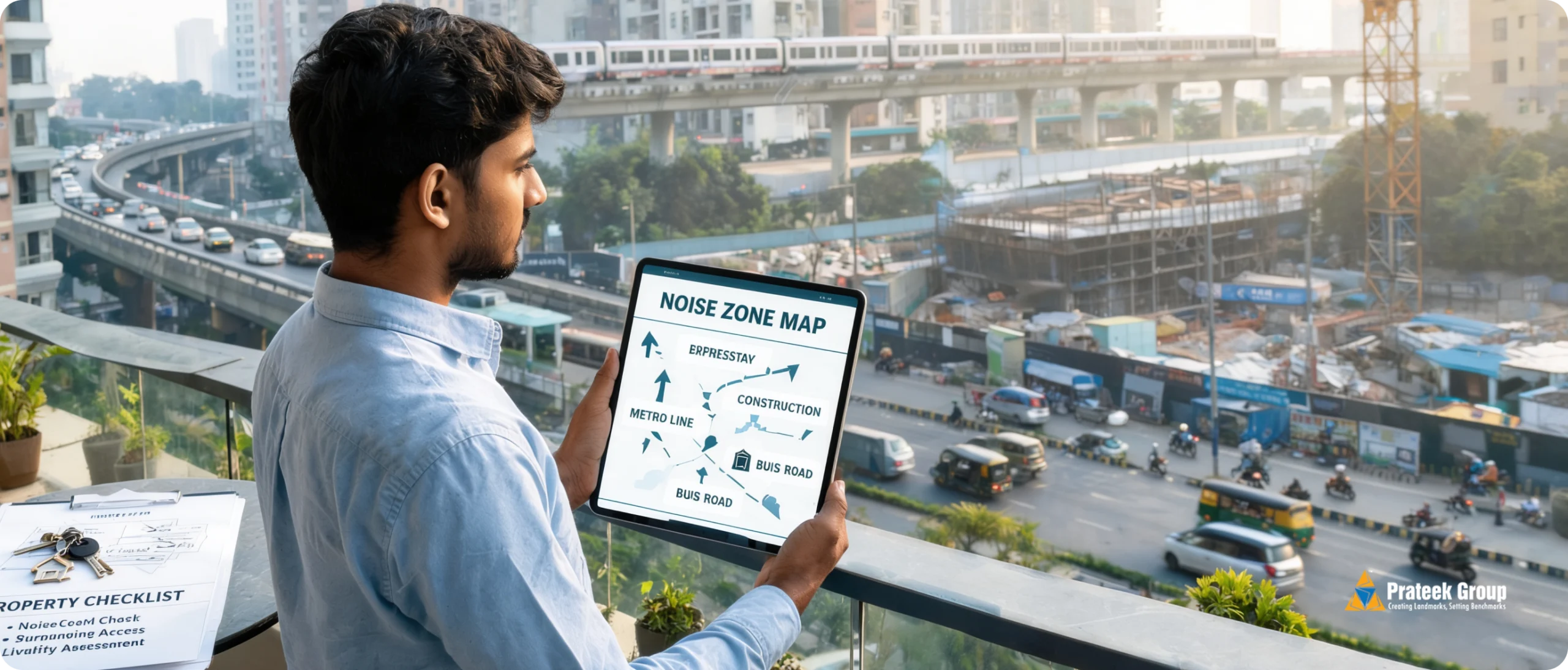
Noise near expressway flats rarely comes from one road line. It may come from the main carriageway, service lane, flyover ramp, U-turn, toll point, school road, commercial frontage, construction site, or entry gate. A buyer who maps the sound source can judge the flat with more confidence.
Start from the tower base. Face the expressway and listen for the broad tyre sound from fast vehicles. Then turn toward the service road. That sound is often sharper because bikes, autos, delivery riders, cabs, and honking happen closer to the project edge. Stand near the entry gate too, because visitor cars, school vans, security checks, and delivery movement can create regular sound even when the main road feels far.
Move up to the flat. Open the balcony door and listen from the living room. Close it and move to the bedroom. A living room can tolerate more sound because people talk, watch TV, or move around there. Sleep needs a stricter reading, especially for children, elderly parents, shift workers, and anyone sensitive to sound.
Use a basic phone noise app if you want a reference, then compare the reading with CPCB noise standards for residential areas. The reading may differ from professional equipment, but it can help you compare 2 units in the same project.
Long exposure matters too. The WHO noise guidance recommends reducing average road-traffic noise below 53 dB Lden because higher road-noise exposure can affect health and sleep. Use simple tools: a phone noise app, 2 visits, and one resident conversation. That is enough to spot many noise pollution near highway concerns before booking.
Run The Window And Balcony Test
The balcony is the easiest place to overjudge. It looks open, bright, and premium during a guided visit. It may feel different during evening traffic or dry-weather dust. Use a small test before you decide how much that balcony is really worth.
Stand in the balcony with the door open for 5 minutes. Do not talk during the first minute. Listen for the kind of sound and the volume. A soft road hum may be acceptable for some buyers. Sudden horns, bus brakes, truck sound, or a flyover curve below the tower may feel more disturbing. If you are comparing flat near highway pros and cons, this open-door test gives better evidence than a brochure line.
Now close the balcony door fully and stand in the living room. Check whether the frame reduces sound or whether the same traffic sound leaks through the track. Then move to the bedroom. Shut every window and sit near the bed wall for 3 minutes. Delhi’s DPCC noise standards list residential day and night limits, so a buyer can compare the site experience with a known benchmark.
Ask about glass thickness, frame material, rubber beading, and window sealing. If the builder mentions acoustic windows for flats, ask whether they are used in every bedroom or only in selected road-facing units. Open and shut the windows yourself. A good-looking window with loose tracks can still pull in sound and dust.
Then repeat the same test in another unit. Road-facing and inner-facing stacks often feel different inside the same project. Balcony usability near expressways depends on direction, floor height, tower gap, wind, traffic hours, and the quality of the door seal.
Track Dust From Approach Road To Bedroom Window
Dust near expressway homes starts before you enter the tower. Walk the last 300 to 500 metres of the approach road. Check dry shoulders, loose soil, broken divider edges, parked trucks, construction material, and open land. If vehicles leave a visible dust trail while moving, that dust can reach balconies and common areas during dry weeks.
Inside the project, look at surfaces that cleaning teams may miss. Check balcony railings, sliding-door tracks, mosquito mesh, outdoor AC ledges, parking ramp corners, lift lobby edges, fire-exit doors, and cars parked near the boundary. If dust returns quickly after cleaning, ask whether it comes from road dust, nearby construction, open plots, or weak sealing.
Use air quality standards as the factual base when PM10 and PM2.5 come up in the conversation. A buyer can use PM10 and PM2.5 as simple reference points while checking dust, filters, and ventilation.
Construction dust needs a separate check. CAQM keeps publishing directions and orders around construction dust rules for Delhi-NCR, including dust control and construction and demolition waste handling. During your site visit, look for covered material, paved access, water sprinkling, debris handling, and whether nearby plots look managed or open to wind.
Dust pollution near construction site zones can reduce after work ends. Road dust from poor shoulders or service lanes may stay longer unless the area is maintained. That difference matters because air pollution near highways is felt indoors too. It shapes how often you clean, whether you open windows, and how much you rely on AC filters or air purifiers.
Read Traffic Through The Resident Route
Gate Exit
Watch the gate during morning peak. If one narrow exit handles residents, school vans, visitor cars, delivery bikes, and guards checking entries, the first delay starts inside the project. Ask whether the society has a second gate, emergency exit, or separate service entry.
Service Road
Drive the actual resident route, including the service lane, slip road, U-turn, and nearest junction. On some stretches, service road congestion affects daily movement more than the expressway itself. The official expressway traffic update helps explain the wider road plan, but the project’s own entry route still needs a ground check.
Daily Pressure Points
Look for petrol pumps, schools, malls, hospitals, office blocks, metro work, parked autos, and delivery clusters. These spots can slow the same stretch every day at fixed hours. If you are checking an NH-24 or Delhi-Meerut Expressway pocket, reports about the Delhi Meerut loop show how a connector can become a local jam and safety issue.
Night Movement
Drive past after 10 pm if the bedroom faces a service lane, bus route, or logistics path. Heavy vehicles may become more visible late evening. This matters for sleep, especially in road-facing flats where windows stay shut for longer hours.
Compare Road-Facing Flats, Floor Height And Inner-Facing Towers
A road-facing flat can be attractive. It may have a wider view, more light, and stronger address visibility. It can also receive more sound and dust if the tower sits close to the road or service lane. The buyer has to compare exact units, not only project names.
Think of floor height in 3 bands. Lower floors may receive service-lane sound, entry-gate noise, and dust from the road edge. Mid floors may sit in the direct line of traffic sound. Higher floors may feel less dusty, but sound can still travel across open land, flyover gaps, and wide roads. Test the higher floor before paying a premium for it.
Tower angle matters too. A flat angled away from the main carriageway may feel calmer than one facing a flyover ramp or U-turn. An inner-facing tower may get less road exposure, but it can still face a club road, school pickup point, basement ramp, or busy internal driveway. Road-facing flats and inner-facing towers both need their own balcony and bedroom test.
Setback distance matters because the space between the road and tower acts like a buffer when it has depth and upkeep. A boundary wall with a narrow strip of dry soil will not behave like a proper green edge. A maintained garden, podium, internal road, and real landscaping buffer can soften the experience, though they cannot remove every sound source.
Local examples show why residents care about this. In Noida, residents near busy elevated roads have asked for a Noida noise barrier after repeated sound concerns. For a buyer, the lesson is simple: compare stacks, floor levels, and directions before paying extra for a view.
Use One Inspection Sheet During The Visit
A buyer should carry one simple sheet during the visit. Before leaving home, check the CPCB AQI portal to understand the wider air condition for the day. Then use the project visit to judge the exact tower, flat, gate, road edge, and resident experience.
| Livability Check | How To Inspect It On Site | Best Time To Check | What To Ask Before Buying |
| Noise level | Stand in the balcony with the door open, then sit in the bedroom with windows shut. Compare road-facing and inner-facing units if both are available. | Evening peak and after 10 pm | Do residents report night sound from trucks, buses, flyovers, or the service road? |
| Dust exposure | Check railings, window tracks, outdoor AC ledges, parked cars, basement ramps, and lift lobby corners. | Dry afternoon | How often does dust return after cleaning? |
| Peak-hour traffic | Stand near the gate and watch resident cars, school vans, cabs, and delivery bikes move in or out. | 8 am to 10 am and 5:30 pm to 8 pm | Is there a second gate, separate service entry, or easier exit route? |
| Night movement | Drive past the project after 10 pm and listen from the approach road. | Late evening | Is there regular truck, bus, or logistics movement near the tower? |
| Service-road congestion | Walk or drive the resident route, including U-turns, petrol pump turns, school roads, and mall entries. | Evening peak | Is the service road complete, maintained, and safe at night? |
| Road-facing unit risk | Open the balcony door, shut bedroom windows, and check dust on the exposed side. | Same hour as inner-unit test | Which road-facing stacks get the most direct sound? |
| Balcony usability | Spend 5 quiet minutes in the balcony and try a normal conversation. | Evening peak | Do residents actually use balconies during traffic hours? |
| Window sealing | Open, shut, and inspect all bedroom windows. Look for air gaps, loose tracks, dust, and weak rubber beading. | Any visit, then repeat during traffic | What glass, frame, and sealing system has been used? |
| Floor height | Check lower, mid, and higher-floor units if possible, using the same sound test. | Evening or night | Does the floor premium match real comfort? |
| Landscaping buffer | Walk between the road edge and tower. Look at green depth, dry soil, paved edges, and maintenance. | Daytime | Who maintains the buffer and how often is it cleaned? |
| Entry-exit movement | Watch the gate during school, office, and delivery hours. | Morning and evening | Do cabs or vans block the entry lane? |
| Resident feedback | Speak to residents, guards, or shopkeepers nearby. | Any visit, better during peak hours | What changes after 10 pm, during winter pollution, and in dry summer weeks? |
Check The Builder’s Planning, Not Just The Project Name
A good builder can make an expressway-side home easier to live in through better tower placement, deeper setbacks, cleaner internal movement, stronger window systems, and better common-area maintenance. This is why buyers should judge the builder’s planning decisions, not only the brand name, launch price, or clubhouse images.
Start With Tower Placement
Ask where the selected tower sits inside the project. A tower placed deeper inside the layout will usually feel different from a tower facing the expressway, service road, entry gate, or commercial edge. Projects such as Prateek Canary in Sector 150 Noida, which the developer describes as a low-density 3 and 4 BHK project across 12.55 acres, should still be inspected tower by tower, because even a green or open-sector project can have road-facing and quieter inner-facing stacks. Use the official Prateek Canary details to understand the project basics, then test the exact unit during the site visit.
Look At Builder Handling After Possession
For ready or occupied projects, the builder’s role shows up in maintenance, dust control, basement cleanliness, road-facing edges, parking ramps, and how residents describe daily issues. Prateek Grand City in Siddharth Vihar, Ghaziabad, for example, sits near NH-24 and is positioned by the developer as a 40-acre ready-to-move township. That kind of large township format gives buyers more internal space to study, but they should still check gate movement, tower distance from the road, basement dust, and resident feedback before deciding. The official Prateek Grand City page gives the location and project context.
Compare With Other NCR Projects
A buyer should also compare how other builders handle expressway-side planning. In Noida, projects such as ATS Pristine, Tata Eureka Park, Godrej Woods, Ace Starlit, ATS Knightsbridge, and SKA Orion are often discussed around connectivity, green spaces, premium positioning, or sector advantages. In Gurgaon and Dwarka Expressway belts, buyers may also see projects by BPTP, Sobha, M3M, Godrej, DLF, ATS, and other NCR builders. The point is not to chase a bigger name. The point is to compare setbacks, road-facing towers, entry-exit planning, green buffers, and window quality across projects.
Keep A Slight Preference For Proven Local Familiarity
For NCR buyers, a builder with long local experience can be easier to evaluate because there may be completed societies, resident feedback, and visible maintenance patterns to inspect. This is where Prateek Group can be considered with a little extra attention, especially for buyers comparing Noida, Ghaziabad, and nearby NCR pockets. A buyer can visit an occupied project, speak with residents, check upkeep, then compare that learning with an under-construction or newer project before booking.
Ask Builder-Specific Questions On Site
Ask the sales team which tower gets the least road sound, whether road-facing bedrooms have upgraded windows, how dust is controlled during construction, how many entry-exit points are planned, and who maintains the green buffer after possession. Ask for these details in writing where possible. Builder reputation matters, but the livability audit should still end at the exact flat, exact floor, exact tower, and exact road outside the project.
Judge Ventilation, Window Sealing And Green Buffers
Air And Tower Exposure
Air quality near expressways has 2 layers: wider city condition and tower-level exposure. Delhi buyers can check Delhi air monitoring before the visit, then compare it with dust on balcony ledges, parking ramps, window tracks, and approach roads.
Ventilation Direction
Stand near both window sides and feel where the air enters. Cross-ventilation feels useful when the incoming side is clean enough to keep open. If the main air path faces a dusty service road or construction plot, the family may depend more on AC, filters, and closed windows.
Window Sealing
Open and shut every bedroom window. Look at rubber beading, sliding tracks, corner gaps, dust inside channels, and the way large glass doors close. Good glass helps, but weak frame fitting can still bring sound and dust into the room.
Filter Dependence
Families with children, elderly parents, asthma concerns, or work-from-home routines may clean filters more often in road-facing homes. Ask how often residents clean AC filters, mesh screens, exhaust vents, and balcony-door tracks during winter and dry summer weeks.
Green Buffer Depth
A green buffer near expressway works better when plants are healthy, soil is covered, paved edges are clean, and the tower has real distance from the road. A green strip helps more when it has depth between the traffic edge and the tower.
How Buying Property Near Expressway Affects Rent And Resale

Expressway-side homes can draw tenants and future buyers because the location is easy to understand. Office access, airport routes, wide roads, and known corridors help a flat get noticed. The Dwarka market report points to growing attention around the micro-market as infrastructure and housing supply moved together.
During an actual rental or resale visit, people judge the unit in the same way you should. They stand in the balcony, check the bedroom window, ask about traffic, and notice dust on surfaces. Resale value near expressway corridors can stay strong when the unit has fewer daily objections.
Consider 2 flats in the same project. One is cheaper and road-facing. The view is wide, but the bedroom catches sound after 10 pm and the balcony gathers dust quickly. Another unit costs slightly more, faces inward, has better window sealing, and exits through a less crowded side of the project. Both carry the same address, but rental demand near expressways often feels easier for the flat that handles daily comfort better.
Wider NCR housing data can help buyers understand active residential submarkets. The final choice still sits at unit level: sound, dust, floor height, gate movement, maintenance, and resident feedback.
Buying property near expressway becomes safer when the price discussion includes livability. A discount on a noisy or dusty unit may work for some buyers. The decision should be informed before booking, especially if the home is meant for family use rather than only investment.
Ask Residents, Guards And Maintenance Staff Before Booking
The best site-visit information often comes from people who use the project every day. Speak to residents if the society is occupied. If it is under construction, speak to guards, nearby shopkeepers, drivers, or residents of older projects in the same pocket. Ask specific questions because vague questions usually get polite answers.
Ask This: Which Tower Gets The Least Road Sound At Night?
This reveals tower orientation, road-facing flats, inner-facing towers, and bedroom directions. Ask the same question to 2 residents if possible, because night sound often feels different from daytime traffic.
Ask This: How Often Does Dust Return After Cleaning?
This tells you whether dust is seasonal, construction-linked, or part of daily road exposure. In Gurgaon, large construction sites have been asked to register on the Gurgaon dust portal, so nearby worksites should be part of your dust questions.
Ask This: Does The Gate Jam During School Or Office Hours?
A resident can tell you whether cars wait inside the society, whether cabs block the lane, and whether school vans crowd the entrance. This is hard to judge from a 20-minute guided tour.
Ask This: Is There Late-Night Truck Or Bus Movement?
A guard may know whether heavy vehicles pass at regular hours. A resident may know whether bedroom windows need to stay shut at night.
Ask This: Are The Approach Roads Safe After Dark?
NCR commuters have raised road safety concerns on stretches where lighting, markings, and visibility affect movement. For a homebuyer, safety around the approach road matters as much as the tower lobby.
Ask This: Which Route Do Residents Actually Use?
The sales route may be cleaner or easier to show. The resident route tells you how the home will function after possession, especially during school runs, office traffic, grocery trips, hospital visits, and late-night entries.
FAQs
Is It Good To Buy A Flat Near An Expressway In NCR?
Yes, when the exact flat passes comfort checks. Visit during peak hours, test balcony sound, inspect bedroom windows, and ask residents about night noise. Expressway access can help commute and resale visibility, while tower direction, floor height, dust, gate movement, and maintenance decide everyday comfort for families.
How Should I Check Noise Near Expressway Flats?
For noise near expressway flats, stand in the balcony with the door open, then sit inside the bedroom with windows shut. Compare both readings with CPCB noise standards and ask residents about sound after 10 pm. Road-facing bedrooms need stricter checks than sample flats and living rooms.
How Do I Check Dust Near Expressway Homes?
Check balcony railings, window tracks, parked cars, outdoor AC ledges, basement ramps, and lift lobby corners. Visit on a dry afternoon, after normal traffic has moved for hours. Ask whether dust comes from traffic, open plots, construction work, service-road soil, weak window sealing, or poor common-area cleaning routines.
Can Traffic Near Expressway Property Affect Daily Comfort?
Yes. The main road may move fast, while the resident route starts at the gate. Watch morning exit, evening entry, school vans, cabs, delivery bikes, U-turns, and service-road congestion. A 5-minute expressway distance loses value if the last 1 km feels slow every working day for the family and staff at home.
Are Road-Facing Flats Always Noisy?
Road-facing flats need closer checks. Some work well when setback, floor height, glass quality, and buffers are strong. Test the same unit during evening and late evening. Compare it with an inner-facing flat before paying for a view, accepting a cheaper exposed stack, or judging only from the sample flat alone.
Are Inner-Facing Towers Better Near Expressways?
Inner-facing towers often feel calmer because another tower, garden, podium, or internal court may sit between the unit and the road. Still check club-road sound, school pickup points, basement ramps, and internal vehicle movement. Inner-facing homes need the same balcony, bedroom, gate-route, and dust test during peak hours.
Which Floor Is Best For Expressway-Side Flats?
There is no fixed best floor. Lower floors may get service-road dust and gate sound. Higher floors may get less dust, yet open land, flyovers, and tower gaps can carry road noise upward. Compare the same stack on lower, middle, and higher floors during evening or night traffic before choosing the flat there.
How Can I Judge Balcony Usability Near Expressways?
Stand in the balcony for 5 minutes during evening traffic. Check if conversation feels normal and whether dust sits on the railing, floor, or outdoor AC ledge. A balcony is usable when it works during real hours, dry weather, and after traffic builds, rather than after fresh cleaning on a guided sales tour.
How Should I Check Air Quality Near An Expressway Flat?
Use the CPCB AQI portal for city-level context, then inspect the actual unit. Check road dust, construction activity, window tracks, balcony ledges, parking areas, and ventilation direction. Public data helps, while tower exposure decides daily cleaning, filter use, window habits, and indoor-air comfort.
What Should Buyers Check In Noida Expressway Flats?
For Noida Expressway flats, check office-hour movement, service-road pressure, nearby construction, institutional traffic, balcony sound, and bedroom windows. A project may suit end users well, but the exact sector, tower direction, floor height, gate route, and distance to daily facilities need in-person testing before booking.
What Should Buyers Check In Dwarka Expressway Flats?
For Dwarka Expressway flats, check the sector road, merge point, service lane, airport-side route, and late-evening movement. The corridor can give strong access, while comfort depends on tower setback, window sealing, gate movement, road-facing stacks, resident routes, and service-road condition during daily use and night.
What Should Buyers Check In Yamuna Expressway Property?
For Yamuna Expressway property, check schools, hospitals, grocery access, fuel points, construction zones, truck movement, and night safety. The corridor can suit buyers with a longer view, while daily comfort depends on how developed the exact pocket feels after possession and how far essentials sit from home.
When Should I Visit Before Booking?
Visit once during morning peak, once during evening peak, and once after 10 pm if the flat faces a busy road. Morning shows exit pressure. Evening shows return traffic. Night shows truck movement, bus braking, and bedroom sound better than a weekend afternoon visit or a guided sample-flat tour before booking.
Can Noise, Dust And Traffic Affect Resale Value?
Yes. Future buyers and tenants notice bedroom sound, balcony dust, parking access, and gate movement during visits. A quieter unit with easier entry and cleaner common areas can reduce objections. A strong expressway address helps visibility, while unit comfort shapes negotiation and rent discussions later.
What Are Hidden Livability Checks Before Buying?
Check tower setback, floor height, road-facing direction, inner-facing options, balcony sound, window sealing, dust on cars, service-road congestion, night traffic, landscaping buffer, parking dust, and resident feedback. These checks show how the flat may feel after possession, during rush hours, and in winter months.
Should I Avoid All Flats Near Expressways?
Many expressway-side flats work well for buyers who inspect the exact unit. Compare towers, test windows, check road distance, visit during real traffic hours, and speak with residents. Good connectivity and daily comfort can sit together when the chosen unit handles sound, dust, access, and maintenance well enough.