
A buyer who shortlisted a ₹3 crore apartment in Noida in 2023 may now be seeing similar homes quoted much higher. A Gurugram buyer may feel the same shock on Dwarka Expressway or Golf Course Extension Road. In South Delhi, builder floors in familiar colonies are touching prices that make even seasoned buyers pause.
So the question is no longer casual: is the NCR luxury real estate market rising on solid demand, or are some buyers paying for a future that has already been priced in?
The question is fair. The NCR luxury real estate market has seen fast price growth, bigger launches, stronger demand for premium homes, and heavy interest in locations such as Gurugram, Noida, South Delhi, and Ghaziabad. ANAROCK reported around 15,200 residential units sold in NCR in Q1 2026, up 21% year-on-year, while new launches stood at around 16,000 units in the same quarter. Luxury and high-end homes together formed a large share of fresh supply. Source: ANAROCK NCR Q1 2026 Residential Market Viewpoints
That does not automatically mean there is an NCR real estate bubble. Strong sales, low inventory pressure, and better infrastructure still support many parts of the market. Yet, some prices now demand a closer look. A ₹5 crore, ₹10 crore, or ₹20 crore home cannot be judged only by launch hype, brochure images, or “limited inventory” claims.
This blog takes a clear view: the NCR luxury real estate market in 2026 does not look like a full bubble everywhere, but some pockets may be moving faster than their real value. For buyers comparing premium homes across Noida, Gurugram, South Delhi, and Ghaziabad, the real question is no longer “Will prices rise?” It is “Which locations still justify the price?”
Buyers should compare each location on practical factors: connectivity, project density, builder track record, resale demand, maintenance quality, and how well the area supports daily life. A luxury home in NCR should not be judged only by launch price or brochure appeal.
Why the NCR Luxury Real Estate Market Is Getting So Much Attention in 2026
A few years ago, most NCR housing conversations were still centred around affordability, possession delays, and whether buyers should trust new launches. In 2026, the conversation feels different. People are now talking about luxury towers, branded residences, larger apartments, golf-side homes, expressway projects, and builder floors selling at prices that would have sounded stretched earlier.
There is a reason behind this shift. After Covid, many upper-income families started looking for larger homes with better ventilation, work-from-home space, club facilities, security, parking, and open surroundings. This pushed demand for luxury homes in NCR, especially in locations where buyers could get better layouts and more managed living than older city homes.
Gurugram remains the most visible luxury market because of its corporate base, Golf Course Road, Golf Course Extension Road, Dwarka Expressway, and Southern Peripheral Road. Noida has gained attention through Sector 150, the Noida-Greater Noida Expressway, and the wider airport-linked growth story. South Delhi is a different case altogether. There, luxury is driven less by new township supply and more by address value, limited land, and redevelopment-led builder floors.
The data also explains why this topic is getting louder. PropTiger reported 17.6% year-on-year price growth in Delhi NCR in Q1 2026, one of the sharper movements among major Indian housing markets. Its report also noted that Delhi NCR continued to see active supply and demand in the quarter. Source: PropTiger Real Insight Residential Q1 2026
Price growth of this kind creates two reactions. Sellers feel confident. Buyers feel nervous.
That is where the bubble debate begins. If prices rise because real end-users are buying better homes in better-connected locations, the market has a stronger base. If prices rise mainly because investors expect quick resale gains, the risk becomes higher. The truth in Delhi NCR luxury real estate sits somewhere between these two points.
Some projects are backed by clear demand, good location, stronger planning, and better delivery confidence. Others are riding on future promises. A buyer looking at luxury real estate in NCR in 2026 needs to separate the two before making a decision.
What Does a Real Estate Bubble Actually Mean?
Before we call the NCR real estate bubble real or fake, let’s pause for a second.
What exactly is a bubble?
A real estate bubble is not just “high prices”. Prices can rise for good reasons. Better roads, stronger office growth, limited land, safer gated communities, and higher income buyers can all push values up. A bubble starts when prices move far ahead of what the market can support.
Think of it this way. If people are buying homes because they want to live there, rent them out, or hold them for a long period, the market has some ground under it. But if buyers are entering only because they believe someone else will pay more in six months, that is where the risk begins.
A few signs usually point towards a bubble:
- Prices rising much faster than incomes or rents
- Heavy investor bookings in new launches
- Weak resale demand after possession
- Large unsold stock despite price hikes
- Developers selling future infrastructure more than present value
- Buyers ignoring location, density, and delivery record
Now ask yourself this: when a luxury apartment in NCR is priced at a premium, is the buyer paying for real value or future hope?
That is the question every serious buyer should ask in 2026.
The NCR luxury real estate market has strong reasons behind its rise, but that does not mean every expensive project is safe. A good project can still be worth its price. A weak project can still look attractive during a market rush. The difference usually becomes clear only when resale, rental demand, and actual occupancy are tested.
A Simple Bubble Check for NCR Buyers
| Bubble Check | Healthy Market Signal | Risk Signal |
| Sales | End-users are buying for use | Bookings are mostly investor-led |
| Prices | Growth follows better infrastructure and demand | Prices rise faster than rents and resale values |
| Supply | New launches match real absorption | Too many luxury launches chase limited buyers |
| Inventory | Overhang stays manageable | Unsold stock rises despite discounts |
| Resale | Buyers exist after possession | Exit depends on launch-stage hype |
So, the better question is not “Is NCR in a bubble?” The sharper question is: which parts of luxury real estate in NCR are supported by real demand, and which parts are running on excitement?
NCR Property Market 2026 Data: Is Demand Strong Enough to Justify the Price Rise?
Market mood can be loud. Numbers are quieter, but more useful.
The NCR property market 2026 is not showing the classic signs of a weak market. ANAROCK reported around 15,200 residential units sold in NCR in Q1 2026, which was 21% higher than Q1 2025. New launches stood at around 16,000 units, up 44% year-on-year. The same report also noted that luxury and high-end homes together formed a major share of fresh supply in the region. Source: ANAROCK NCR Q1 2026 Residential Market Viewpoints
That is a strong demand signal. But look closer.
If sales are rising and launches are rising at the same time, the market is active. Yet, when a large part of new supply moves towards high-end and luxury homes, the market starts depending on a smaller buyer base. How many families can comfortably buy a ₹3 crore, ₹5 crore, or ₹10 crore home without stretching too far? How many investors can hold such properties if resale slows?
PropTiger’s Q1 2026 report also showed firm price movement in Delhi NCR, with the region recording 17.6% year-on-year price growth. Source: PropTiger Real Insight Residential Q1 2026
That figure is important. A 17% plus annual jump is not small. For someone who delayed a purchase by one year, the same property may now feel much more expensive. For someone who bought early, it feels like smart timing. For someone buying today, the pressure is different: they must judge whether the next few years can still support that price.
Inventory gives another clue. ANAROCK reported NCR’s available inventory at around 91,250 units in Q1 2026, with an inventory overhang of about 18 months. Source: ANAROCK NCR Q1 2026 Residential Market Viewpoints
An 18-month overhang does not scream crisis. In fact, it suggests that homes are still getting absorbed. That is why calling the entire NCR luxury real estate market a bubble would be too simple.
But here is the catch: averages hide local risks.
Gurugram is not South Delhi. South Delhi is not Noida. Noida is not Siddharth Vihar. A luxury floor in Defence Colony, a premium apartment on Dwarka Expressway, and a planned residential community in Noida Sector 150 all behave differently.
This is where buyers should slow down. Strong regional data does not make every project a safe bet.
Why Luxury Housing Demand in NCR Is Still Strong, Even When Prices Feel Stretched
The uncomfortable truth is that luxury demand in NCR is not imaginary.
People are buying. Families are upgrading. Many buyers are no longer looking at luxury only as marble flooring, a clubhouse, or a fancy lobby. They want larger homes, better parking, controlled entry, cleaner common areas, stronger maintenance, and a society that works well after possession. That is why the luxury housing market in NCR has continued to find buyers even after sharp price increases.
Think about the buyer profile. A business family in West Delhi may look at Gurugram because of office access and established premium communities. A senior corporate professional may prefer Golf Course Extension Road or Dwarka Expressway for newer apartments. A Noida-based buyer may compare Sector 150, Sector 128, Sector 146, or Sector 107 because these locations offer larger gated projects and expressway access. In Ghaziabad, Siddharth Vihar appeals to buyers who want better space and connectivity without entering the highest NCR price brackets.
This is where comparison becomes important. Buyers comparing luxury homes across NCR often look at established and emerging options from developers such as DLF, M3M, Godrej Properties, ATS, Max Estates, County Group, Mahagun, and Prateek Group. The smarter comparison is not brand name alone, but location strength, possession stage, layout efficiency, density, resale demand, and long-term maintenance quality.
For Noida and Ghaziabad buyers, internal project references such as Prateek Canary and Prateek Grand City can be used as comparison points for layout, location, and community planning, along with other available projects in the same micro-markets.
These projects do not serve the same buyer, even though many of them sit inside the wider NCR luxury real estate market.
Some are priced for ultra-luxury buyers. Some are for upper-mid luxury families. Some depend heavily on location scarcity. Some depend on upcoming infrastructure. Some are better for end use, while others attract investors looking at future appreciation.
ANAROCK’s Q1 2026 data supports this demand story. NCR recorded around 15,200 residential unit sales, up 21% year-on-year, and Gurugram alone accounted for a large share of regional activity. Source: ANAROCK NCR Q1 2026 Residential Market Viewpoints
So, is demand strong? Yes.
But should every buyer assume that every luxury launch will keep rising? No.
That is where the market becomes tricky. Luxury homes in NCR are selling, but the reason behind each purchase matters. A family buying for long-term use may judge the home differently from an investor booking during launch week. One is looking at daily life. The other is looking at exit value.
And in 2026, that difference matters more than ever.
Price Growth in Delhi NCR Luxury Real Estate: Smart Appreciation or a Warning Sign?
Fast price growth always feels exciting when you already own the property.
It feels very different when you are the next buyer.
The Delhi NCR luxury real estate market has seen sharp appreciation over the last few years. PropTiger reported 17.6% year-on-year price growth in Delhi NCR in Q1 2026, which shows how quickly average values have moved. Source: PropTiger Real Insight Residential Q1 2026
ANAROCK’s Q1 2026 data also shows a steep long-term movement in NCR’s average quoted residential price, from around ₹4,600 per sq. ft. in Q1 2021 to about ₹9,620 per sq. ft. in Q1 2026. Source: ANAROCK NCR Q1 2026 Residential Market Viewpoints
Now ask the practical question: has the quality of every project doubled in the same period?
That is where buyers need to slow down.
Some price growth is justified. Better roads, metro expansion, expressway access, stronger office markets, airport-linked expectations, and improved developer confidence have helped many locations. Gurugram’s premium pockets have strong corporate demand. Noida’s expressway belt has gained from planned infrastructure and larger land parcels. South Delhi has limited land and address value. Ghaziabad’s better-connected pockets are attracting buyers who want space at comparatively lower prices.
But NCR property prices are not rising equally for the same reasons.
A luxury floor in South Delhi may rise because supply is limited. A Gurugram apartment may rise because of office demand and lifestyle infrastructure. A Noida project may rise because of expressway access and future airport expectations. A Ghaziabad project may rise because buyers are being priced out of central Noida and Gurugram.
Same price growth. Different logic.
This is why the NCR real estate bubble debate cannot be answered with one simple yes or no. A bubble risk becomes stronger when prices rise mainly because buyers expect the next buyer to pay more. It becomes weaker when prices are supported by real use, better connectivity, low unsold stock, and steady occupancy.
Magicbricks reported that some South Delhi luxury builder-floor markets saw price increases of 23% to 32% in select colonies, including Defence Colony, Safdarjung Enclave, and Greater Kailash. Source: Magicbricks South Delhi Luxury Housing Report
That kind of rise needs careful reading. South Delhi is not a mass-supply market. Land is limited, addresses are established, and many buyers are paying for location as much as the home. Still, when prices move too quickly, even strong markets can become sensitive to resale slowdown.
For buyers, the safer approach is simple: compare the price with rental value, resale demand, project density, possession timeline, builder record, and actual location strength. If all of these support the price, appreciation may be healthy. If most of the price depends on future promises, the risk is higher.
Would you still buy the same home if prices stayed flat for three years? That one question often tells whether the purchase is based on real value or market pressure.
That is the line between smart appreciation and overheating in the NCR luxury real estate market.
Gurugram Luxury Real Estate: Strong Market or Overpriced Bet?
Gurugram has become the headline market for luxury housing in NCR. If someone says prices are running hot, they are often talking about Golf Course Road, Golf Course Extension Road, Dwarka Expressway, SPR, or newer premium sectors near major corporate hubs.
But here is the real question: are buyers paying for today’s value, or already paying for the next five years?
Gurugram’s strength is not imaginary. The city has office districts, premium schools, hospitals, hotels, malls, and a strong base of senior professionals, business owners, and HNI buyers. This gives Gurugram luxury real estate a deeper demand base than many speculative corridors.
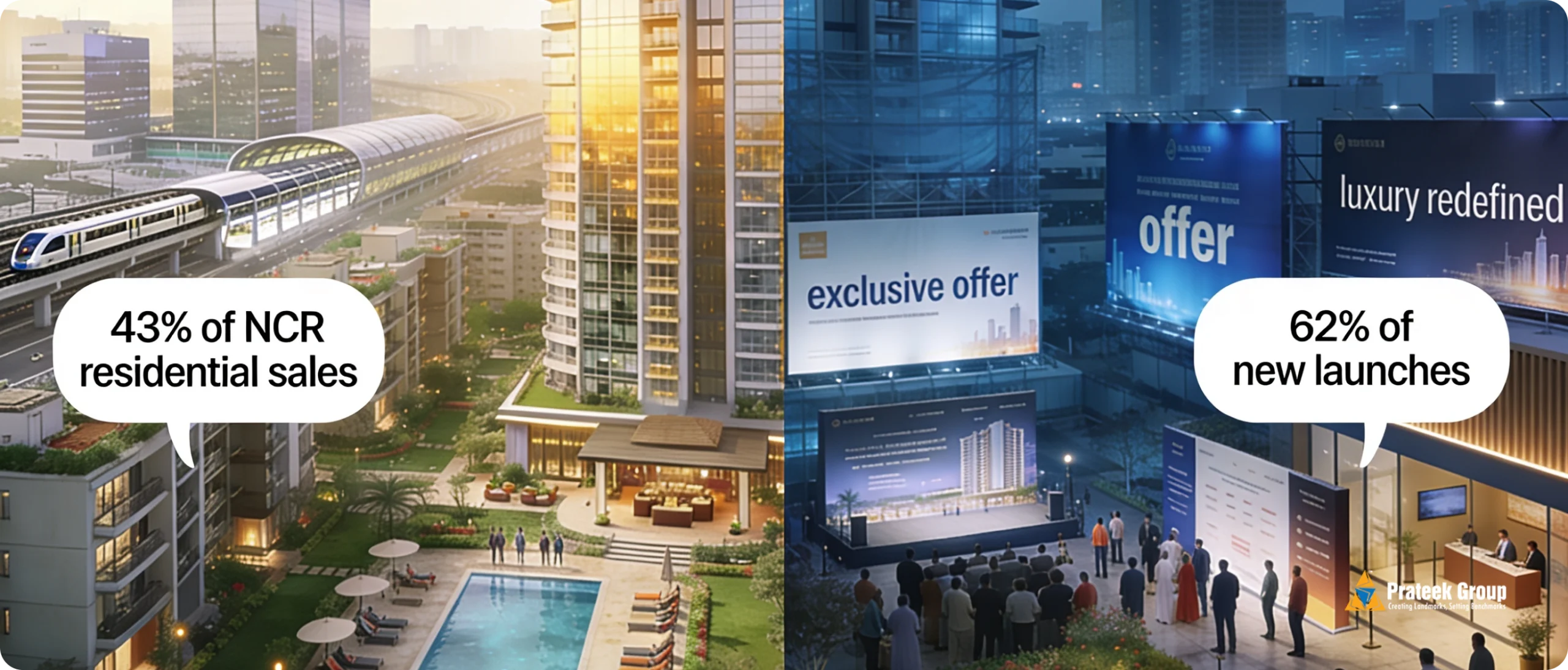
ANAROCK reported that Gurugram accounted for around 43% of NCR residential sales and 62% of new launches in Q1 2026. That shows how heavily the region’s housing activity is concentrated here. Source: ANAROCK NCR Q1 2026 Residential Market Viewpoints
Where Gurugram Looks Strong vs Where Buyers Should Pause
| Gurugram Pocket | What Supports Demand | What Buyers Should Check |
| Golf Course Road | Mature luxury address, strong resale demand, limited fresh supply | Very high entry price and older building quality in some societies |
| Golf Course Extension Road | Premium projects, office access, good social infrastructure | Traffic load, maintenance cost, and project-level density |
| Dwarka Expressway | Newer luxury launches, airport-side connectivity, Delhi access | Whether today’s price already includes future infrastructure gains |
| SPR / New Gurgaon | Larger projects, developing commercial belt, relative price advantage | Actual occupancy, road completion, and resale liquidity |
The project mix is also wide. Developers such as DLF, M3M, Emaar India, Godrej Properties, Smartworld, and Sobha compete across different price bands. A buyer is not simply choosing a flat. They are choosing a pricing logic.
Some projects sell location maturity. Some sell new things. Some sell clubhouse scale. Some sell brand comfort.
That is why luxury apartments in NCR should never be compared only by per-square-foot price. A cheaper project in a weaker location may be more expensive in the long run if resale demand stays thin. A costly project in a proven location may still hold value better if occupancy, rental interest, and buyer confidence remain strong.
Reader Check: Ask These Before Buying in Gurugram
- Is the price based on current liveability or future promise?
- Does the location already have enough schools, markets, hospitals, and office access?
- Are similar resale homes moving at the same rate as new launch prices?
- Is the builder known for delivery and maintenance quality?
- Will the monthly maintenance cost make sense for your budget?
Gurugram does not look like a weak market. But parts of it look aggressively priced. For real estate investment in NCR, that means buyers need to be very selective. The right Gurugram property may still perform well. The wrong one may take longer to justify its price.
Noida Luxury Real Estate: Infrastructure Story or Real End-User Market?
If Gurugram’s luxury story is built around corporate demand and mature private-sector growth, Noida’s story is more infrastructure-led. That difference matters because it changes how buyers should judge risk.
Noida’s premium housing growth is tied closely to expressway connectivity, planned sectors, larger land parcels, and the long-term impact of Jewar Airport.
That makes the market exciting. It also makes it easier to overpay.
Many buyers are now looking at Sector 150, Sector 128, Sector 107, Sector 146, Sector 94, and the Noida-Greater Noida Expressway belt. Some want lower-density surroundings. Some want bigger apartments than they can afford in Delhi or Gurugram. Others are entering because they believe airport-linked growth will lift prices further.
The Noida luxury real estate market has genuine strengths, but buyers should avoid treating every expressway-side project as equal.
What Is Driving Luxury Demand in Noida?
| Driver | Why It Matters | Buyer Risk |
| Noida-Greater Noida Expressway | Better movement towards corporate parks, Greater Noida, and Delhi | Projects far from daily-use infrastructure may feel inconvenient |
| Sector 150 planning | Green surroundings, sports-city positioning, lower-density appeal in many projects | Price premium can be high compared with current social infrastructure |
| Jewar Airport expectations | Long-term economic and connectivity impact | Some prices may already include benefits that will take years to mature |
| Larger gated projects | More open space, amenities, and planned community living | High density inside some projects can reduce the luxury feel |
| Better affordability than Gurugram luxury pockets | Bigger homes may be available at a lower ticket size | Resale depth may vary by sector and builder |
Noida has several premium developers and housing pockets that buyers often compare, including ATS, Godrej Properties, Max Estates, County Group, Mahagun, and Prateek Group. The comparison should not stop at brochure features. A buyer should compare possession status, carpet area efficiency, tower spacing, approach roads, nearby occupancy, and long-term maintenance planning.
A Simple Way to Read Noida’s Luxury Market
Noida has three types of luxury demand right now:
- End-user demand from families who want larger homes, expressway access, and planned living.
- Upgrade demand from buyers moving out of older Noida sectors or Delhi homes.
- Investor demand linked to airport, metro, and expressway-led price expectations.
The first two are healthier. The third can be profitable, but it carries more risk.
A project near strong daily-use infrastructure usually has a better base. A project that depends mainly on “future growth” needs a longer holding period and stronger risk appetite.
That is the part many buyers miss. Infrastructure growth in NCR can lift property values, but it does not lift every project equally. Location inside the corridor still matters. Builder delivery still matters. Actual occupancy still matters.
The Jewar Airport impact on real estate may be meaningful over time, especially for Noida, Greater Noida, and Yamuna Expressway markets. But buyers should be careful when a sales pitch makes future airport benefits sound immediate. Infrastructure improves value gradually. Prices often react much earlier.
So, is Noida becoming a luxury hotspot? Yes.
Is every premium project in Noida safe at any price? No.
That difference can save a buyer from making an expensive mistake in the NCR luxury real estate market.
Ghaziabad and Siddharth Vihar: The More Practical Luxury Conversation
Ghaziabad and Siddharth Vihar sit in a different price conversation. They do not compete directly with South Delhi or Golf Course Road luxury, but they attract buyers who want larger homes, better connectivity to Delhi, and planned society living at a relatively lower ticket size.
This part of the NCR luxury real estate market is more practical than flashy. Buyers here usually look at space, road access, possession status, daily convenience, and whether the location can hold value over time. NH-24/NH-9 connectivity, access towards Indirapuram, Noida, and Delhi, and the quality of surrounding infrastructure matter more than brochure language.
The key question is simple: does the location work for daily life today, or is the buyer depending too much on what the area may become later?
For this market, buyers should check actual occupancy, nearby schools and markets, approach roads, project density, maintenance quality, and resale movement after possession. Projects by developers such as Prateek Group can be compared here with other Ghaziabad and Noida options on location, layout efficiency, possession stage, and community planning.
This is also where buyers should be careful with the word “luxury”. A bigger apartment or better clubhouse does not automatically make a project premium. In Ghaziabad and Siddharth Vihar, real value often comes from usable space, connectivity, liveability, and whether the project can remain attractive after the first wave of buyers moves in.
South Delhi Luxury Real Estate: Scarcity Market or Bubble Zone?
South Delhi does not behave like the rest of the NCR luxury real estate market. It has limited land, older premium colonies, redevelopment-led supply, and buyers who often pay for the address first and the structure second.
That is why prices in areas such as Defence Colony, Greater Kailash, Safdarjung Enclave, Vasant Vihar, and Panchsheel Park can rise sharply even when new supply is limited. The market is smaller, but the ticket size is much higher.
A Magicbricks report noted that some South Delhi luxury builder-floor markets saw price growth of 23% to 32% in select Category B colonies during Q1 2026. That is a strong rise for an already expensive market. Source: Magicbricks
So, is South Delhi luxury real estate in a bubble? The answer is not simple. Scarcity supports prices, but scarcity alone cannot justify every jump. Buyers still need to check construction quality, parking, floor rights, resale demand, maintenance condition, and legal clarity.
Here is the catch many buyers miss: South Delhi prices are often driven by emotion as much as calculation. People buy because the address carries status, family familiarity, school access, and social comfort. That makes demand sticky, but it can also push prices beyond rental logic.
For end-users, South Delhi can still make sense if the location fits daily life and the home will be held for years. For investors, the entry price needs closer testing. When luxury property prices in NCR rise too fast, resale timing becomes important.
A strong address is not always a safe investment at any price.
Is Luxury Supply in NCR Moving Faster Than Real Demand?
Supply is the part of this story that buyers should watch more carefully.
The luxury housing market in NCR is not only seeing demand; it is also seeing a clear supply shift. Developers are launching more high-end homes because premium buyers are active and margins are better in this segment.
ANAROCK reported that NCR saw around 16,000 new launches in Q1 2026, up 44% year-on-year. The same report said luxury and high-end homes together formed a major part of new supply, with the luxury segment alone contributing around 31%. Source: ANAROCK NCR Q1 2026 Residential Market Viewpoints
That sounds positive at first. More supply means more choices. Better homes, larger layouts, stronger amenities, and planned communities are good for buyers.
But here is the question: how many buyers can actually absorb this premium supply at current prices?
The risk is not immediate oversupply across NCR. The concern is concentration. If too many projects chase the same upper-income buyer, some micro-markets may start showing slower resale, longer holding periods, or higher negotiation after possession.
ANAROCK’s Q1 2026 data also showed NCR’s available inventory at around 91,250 units, with an inventory overhang of about 18 months. That does not look alarming right now. Source: ANAROCK NCR Q1 2026 Residential Market Viewpoints
Still, buyers should watch the direction of NCR housing supply carefully. If launches keep moving towards luxury while real end-user demand grows slower, the market may become more selective.
A healthy luxury market sells because people want to live there. A risky market sells because buyers believe prices will rise forever. The difference may not show during launch week. It usually shows after possession, when resale and occupancy are tested.
End-User Demand vs Investor Demand: Who Is Really Holding the NCR Luxury Market?
Every property cycle has two types of buyers.
One buys because the home fits their life. The other buys because they expect the price to rise. Both are part of the NCR luxury real estate market, but they do not carry the same risk.
End-user demand is usually healthier. These buyers care about school access, office travel, family space, parking, security, ventilation, maintenance, and long-term comfort. They may negotiate, but they are not waiting only for a quick exit.
Investor-driven demand behaves differently. It often follows launch buzz, early-bird pricing, airport stories, expressway claims, or the fear that “prices will never come down again.” That type of buying can lift prices quickly, but it can also create pressure later.
End-User vs Investor Demand in NCR Luxury Homes
| Buyer Type | What They Usually Look For | Risk Level |
| End-user buyer | Liveability, layout, location, family comfort, maintenance quality | Lower, if the price is sensible |
| Long-term investor | Strong location, rental demand, resale depth, builder trust | Moderate |
| Short-term investor | Launch discount, fast appreciation, resale premium | Higher |
| Speculative buyer | Future infrastructure claims, market buzz, peer pressure | Very high |
Here is a simple question for readers: if resale does not happen for three years, will the purchase still make sense?
If the answer is yes, the decision may be more grounded. If the answer is no, the buyer is depending too much on market speed.
That is where real estate investment in NCR needs more discipline in 2026. Price growth has been strong, but the next phase may reward only selected locations and better-planned homes.
A luxury home should not be judged only by how fast it sold during launch. The real test begins later: occupancy, resale demand, rental interest, maintenance experience, and whether families actually want to live there.
Warning Signs Buyers Should Watch Before Investing in NCR Luxury Real Estate

The market may be strong, but buyers still need to protect themselves. A rising market can hide weak decisions for some time. When the cycle slows, those mistakes become visible.
Before buying into luxury real estate in NCR, check these warning signs carefully.
Red Flags That Deserve a Second Look
- The price is much higher than nearby resale properties without a clear reason.
- The sales pitch depends heavily on future infrastructure, not current liveability.
- Rental yield looks weak compared with the total investment.
- The project has high density, but is marketed as luxury.
- Construction progress does not match payment demand.
- The location has poor last-mile access.
- Similar homes are available for resale, but buyers are still being pushed towards new launch pricing.
- Maintenance charges are unclear or look unusually high.
- The project has limited actual occupancy nearby.
- The builder’s past delivery record is difficult to verify.
The biggest mistake is buying only because prices have already risen. That is not research. That is fear.
A buyer should compare the total cost, not just the basic price. Stamp duty, GST where applicable, club charges, parking, maintenance deposit, fit-out cost, and monthly society expense can change the real value of the deal.
The NCR property market 2026 still has strong pockets, but every premium location is not automatically safe. Some homes are priced for real demand. Some are priced for perfect future conditions.
Ask one more uncomfortable question: if the market corrects by 10%, will this property still feel like a good purchase?
That answer tells you more than any brochure.
Final Verdict: Bubble, Boom, or Selective Overheating in NCR Luxury Real Estate?
The honest answer is this: the NCR luxury real estate market does not look like a complete bubble in 2026.
There is real demand. Sales have remained active. ANAROCK reported around 15,200 residential units sold in NCR in Q1 2026, with available inventory at around 91,250 units and inventory overhang near 18 months. That does not look like a market where buyers have disappeared. Source: ANAROCK NCR Q1 2026 Residential Market Viewpoints
Still, parts of the market are clearly expensive. PropTiger reported 17.6% year-on-year price growth in Delhi NCR in Q1 2026, while Magicbricks reported sharp jumps in select South Delhi luxury builder-floor pockets. Source: PropTiger Real Insight Q1 2026, Source: Magicbricks South Delhi Luxury Housing Report
So, what should we call this market?
Not a full bubble. Not a simple boom either.
A better description is selective overheating.
Strong locations with real end-user demand, good connectivity, low practical supply, and reliable delivery may continue to hold value. But overpriced projects, investor-heavy launches, and locations selling mostly on future promises need caution.
For buyers, the safest approach is not to ask, “Will NCR prices rise?” The better question is, “Does this particular home justify this particular price today?”
In 2026, the safest buyer in NCR is not the one chasing the fastest-rising price. It is the one asking whether the home still makes sense if the market slows down.
FAQs on the NCR Luxury Real Estate Market in 2026
1. Is the NCR luxury real estate market in a bubble in 2026?
The full market does not look like a bubble, but some pockets look overheated. Demand is still active, inventory is not at crisis levels, and premium buyers are present. The risk is higher in projects where prices depend more on future expectations than current value.
2. Why are luxury property prices rising so fast in NCR?
Prices are rising because of higher demand for larger homes, better gated communities, limited quality supply in prime areas, infrastructure upgrades, and stronger buyer confidence. In some locations, investor interest has also pushed prices up faster.
3. Which NCR locations are seeing the strongest luxury housing demand?
Gurugram, South Delhi, Noida, Greater Noida Expressway pockets, and selected Ghaziabad micro-markets are seeing strong interest. Each market behaves differently, so buyers should compare location quality, resale demand, and daily-use infrastructure before deciding.
4. Is Gurugram luxury real estate overpriced?
Some Gurugram pockets are expensive, but not all are weak. Mature locations with office access, resale demand, and strong social infrastructure may justify higher prices. The risk is higher where prices already include future growth that has not fully arrived.
5. Is Noida luxury real estate a good investment in 2026?
Noida can be a good long-term market if the project has strong connectivity, good planning, reliable delivery, and real end-user demand. Buyers should be careful with projects priced mainly around airport or expressway expectations without strong current liveability.
6. Why is South Delhi luxury real estate so expensive?
South Delhi prices are driven by limited land, established addresses, redevelopment demand, and strong local buyer preference. It is not a mass-supply market, so scarcity supports pricing. Still, buyers should check legal clarity, construction quality, parking, and resale value.
7. Can NCR luxury property prices correct in 2026?
A broad crash does not look certain from current data, but correction can happen in selected projects or micro-markets. Overpriced launches, weak resale demand, poor location access, or slow construction can create price pressure.
8. What is the biggest risk in buying luxury homes in NCR now?
The biggest risk is overpaying for future promises. Buyers should check whether the current price is supported by location strength, real demand, rental value, resale depth, construction progress, and builder track record.
9. Are luxury apartments in NCR better for end-use or investment?
Luxury apartments in NCR can work for both, but the buying logic should be different. End-users should focus on liveability, comfort, and long-term convenience. Investors should focus more on resale demand, rental yield, entry price, and holding period.
10. How can buyers avoid a bad luxury property decision in NCR?
Buyers should compare nearby resale prices, check actual occupancy, review the builder’s delivery record, study the location beyond brochure claims, and calculate the full cost of ownership. A luxury home should make sense even if prices do not rise quickly.