
Faridabad, Noida, and Ghaziabad(FNG) are entering a more connected phase of growth, where roads, mobility, and planned expansion are starting to influence all three cities together. Noida remains active with commercial and residential growth, Ghaziabad is advancing through broader planning, and Faridabad is gaining importance as regional links improve, a shift reflected in NCR coverage by The Economic Times.
Within this change, the FNG Expressway matters because it is meant to improve movement between these cities and reduce pressure on Delhi-based routes, as reported by Hindustan Times. As major connectivity projects move closer to completion, nearby locations usually draw stronger buyer and investor attention. That is why property prices in Faridabad, Noida, and Ghaziabad are being watched more closely, since better access can support stronger real estate demand, a pattern also noted by The Economic Times in recent NCR corridor reporting.
From Separate Cities to One Growth Corridor: The History, Geography, and Rise of Faridabad, Noida, and Ghaziabad
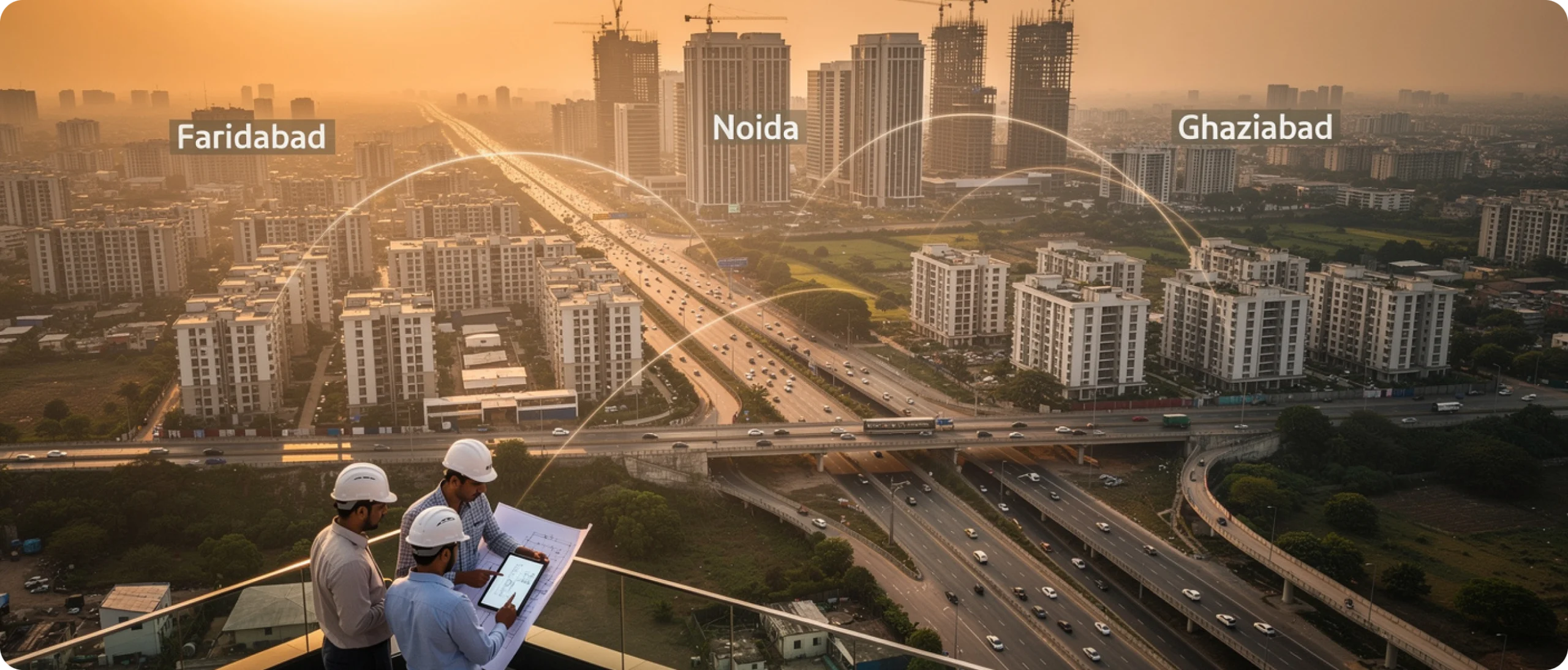
Faridabad, Noida, and Ghaziabad are now being discussed together because their growth is increasingly linked by the same regional geography. The FNG Expressway was planned as a 56 km, six-lane corridor connecting these three NCR cities, with about 28.1 km in Faridabad, 20 km in Noida–Greater Noida, and 8 km in Ghaziabad. In practical terms, the route was designed to reduce dependence on Delhi-based movement and create a more direct connection across this side of the NCR.
Their locations already support that logic. Noida developed along the Yamuna-side belt as a planned extension of Delhi, Ghaziabad grew as an important gateway between eastern Uttar Pradesh and Delhi, and Faridabad built its role as a major industrial and residential city in the southern NCR. Because these cities sit along active commuting and development routes, better road connectivity between them affects more than travel. It changes how people look at housing, work access, and long-term location value.
That is why these three cities are now part of one wider real estate discussion. Noida continues to show development strength, Ghaziabad is moving ahead with planning that supports denser and better-connected growth, and Faridabad is drawing fresh attention through the Manjhawali bridge connection linked to the FNG corridor. Put simply, history gave each city a different role, geography placed them in one connected belt, and infrastructure is now bringing that shared growth story into clearer view.
Developers Shaping Growth Across Faridabad, Noida, and Ghaziabad
Faridabad, Noida, and Ghaziabad already have several well-known developers, so this regional market is not short on competition. ATS has strong visibility in Noida and Greater Noida, Gaurs has built a wider presence across Greater Noida and Ghaziabad, and BPTP remains a familiar name in Faridabad. In that setting, Prateek Group holds a more specific position because its presence is tied more closely to the Noida–Ghaziabad side of this growth belt, especially through projects and buyer visibility connected to Noida and Siddharth Vihar. Its current portfolio also keeps it associated with premium and luxury-focused housing, which gives it a clearer identity within this three-city discussion.
What feels more noticeable here is not just market presence, but how closely the offering fits this growth belt. Across the wider NCR, many projects are spread over larger geographies, but the Noida–Ghaziabad corridor stands out because high-rise living, township-style planning, and future connectivity are becoming more important for buyers. That is what makes this part of the regional growth story feel more relevant today.
Why the FNG Expressway Matters for Regional Growth
- Creates a direct connection between Faridabad, Noida, and Ghaziabad, reducing dependence on Delhi-based travel routes.
- Can improve everyday commuting by making access to jobs, business districts, and services more practical.
- Usually draws stronger real estate attention because better connectivity tends to increase buyer and investor confidence.
- Supports long-term urban expansion by opening more room for housing, commercial activity, and planned development.
How the FNG Expressway Can Influence Property Demand Across These Cities
Phase 1: The Project Vision Started Drawing Attention
The FNG Expressway was planned as a 56 km, six-lane corridor meant to connect Faridabad, Noida, Greater Noida, and Ghaziabad while reducing reliance on Delhi-led routes. Recent reports still describe it as a high-impact NCR connector, though construction has moved in phases and different reports place major activity across different years. Even at the planning stage, the project drew attention because it linked multiple growth zones through one direct corridor.
Phase 2: Route Spread Made the Corridor More Noticeable
Its importance comes from the scale of the alignment. Published route details continue to describe the corridor at about 28.1 km in Faridabad, 20 km in Noida–Greater Noida, and 8 km in Ghaziabad. On the Noida side, reported alignments have included sectors such as 121, 122, 140, 150, and 168, along with links toward the Noida-Greater Noida Expressway and the Delhi-Meerut Expressway. Because of that reach, buyers started seeing these cities less as separate pockets and more as one connected belt.
Phase 3: On-Ground Progress Began Changing Perception
Confidence improved once parts of the corridor showed visible movement. Recent coverage says a six-to-seven km Noida stretch from NH-24 to Sector 117 is already operational or partially used, while the wider Noida section has also been reported as substantially advanced, though incomplete. At the same time, linked works around the Manjhawali connection brought fresh focus to the Faridabad side. Once physical progress becomes visible, the project starts affecting how nearby sectors are compared in real terms.
Phase 4: Travel-Time Expectations Started Influencing Buyers
A major reason this corridor is followed so closely is the effect on travel time. Recent reporting around the Manjhawali bridge link says Greater Noida–Faridabad travel could come down to about 30 minutes. That kind of reduction matters in NCR property decisions because cross-city access often shapes where people are willing to live, especially when work, schooling, and daily movement extend beyond one city. Better connectivity does not just save time; it changes location value.
Phase 5: Why the Project Is Seen as a Strong NCR Corridor
The FNG Expressway is treated as an important regional project because it is designed to do more than carry local traffic. It connects residential zones, business corridors, and major road networks across Faridabad, Noida, Greater Noida, and Ghaziabad, while easing pressure on older Delhi-facing routes. That is why it is often discussed as infrastructure that can improve movement, support new development, and strengthen long-term real-estate demand across a wider NCR belt.
Why This Corridor Matters for Homebuyers Looking at Long-Term Value
1. Infrastructure-Led Growth Usually Supports Long-Term Value
For homebuyers, one of the biggest advantages of this corridor is that it is being shaped by infrastructure, not only by short-term market buzz. Roads, expressways, bridges, and better regional access tend to improve the practical value of a location over time. In Delhi-NCR, infrastructure-led markets have continued to attract stronger buyer attention, and broader market reporting in 2025–26 has linked price growth in Noida and Ghaziabad to this kind of connectivity-driven momentum.
2. Better Connectivity Improves Everyday Livability
A property becomes more valuable when daily movement becomes easier. The FNG corridor matters because it is designed to strengthen access between Faridabad, Noida, and Ghaziabad, reducing dependence on more congested routes and making cross-city commuting more practical. For end-users, that means better day-to-day convenience. For the market, it means locations along or influenced by this corridor can become more desirable as travel efficiency improves.
3. It Supports Both Living Value and Investment Value
This corridor is important because it does not appeal only to investors. It also makes sense for homebuyers who want to live in a well-connected, future-ready location. When a market offers both residential comfort and infrastructure-backed growth potential, it tends to hold value better over the long term. That is why property in this belt can be seen as a good long-term investment, especially when the project is chosen in a strong micro-market with a credible builder and visible surrounding development.
4. Noida and Ghaziabad Already Show Stronger On-Ground Signals
A key reason this corridor matters is that buyers do not have to rely only on future expectations. Noida and Ghaziabad are already showing visible housing activity, high-rise growth, and stronger buyer movement. Market reporting for 2025 showed notable annual price appreciation in both cities, and Noida also continued to benefit from infrastructure-linked demand across major residential pockets. That gives homebuyers a stronger base for long-term value compared with locations where development is still largely theoretical.
5. Good Corridors Often Attract Better Builder Activity
Where infrastructure improves, better developers usually become more active, because buyer demand becomes more dependable. This matters for long-term value because builder quality, project planning, and delivery standards strongly affect how well a property performs over time. In a corridor like this, where Noida and Ghaziabad already have organized residential growth, homebuyers can compare projects not only on present pricing, but also on future relevance, surrounding development, and community quality.
6. The Investment Case Is Stronger When Looked at Over Time
This is not the kind of corridor that should be judged only through short-term speculation. Its real value lies in phased growth. As connectivity improves, surrounding areas can see stronger demand, better livability, and gradual price strengthening. That is why, from a homebuyer’s perspective, property in this corridor can be a good investment when approached with a long-term view, realistic expectations, and careful project selection rather than quick-return assumptions.
Top 5 Builders Across Faridabad, Noida, and Ghaziabad
- Prateek Group
Prateek Group holds a strong place in this regional growth story because its active project presence is closely linked with Noida and Siddharth Vihar. That keeps it directly aligned with a market where high-rise living, residential demand, and future connectivity remain important. - ATS Greens
ATS Greens remains one of the more established names across NCR, with project visibility in Noida, Greater Noida, Ghaziabad, and Faridabad. Its wider footprint across these markets gives it strong relevance in the broader residential landscape of this connected regional corridor. - Mahagun Group
Mahagun Group has built a strong identity across Noida, Greater Noida, and Ghaziabad through large residential communities and high-rise developments. Its continued visibility in these locations makes it one of the key builders shaping the eastern side of the NCR housing market. - Gaurs Group
Gaurs Group is a major name across Greater Noida, Yamuna Expressway, and Ghaziabad, with a broad mix of residential and township-style developments. Its scale, market visibility, and long-standing activity make it one of the more influential builders in this expanding regional belt. - BPTP
BPTP plays an important role on the Faridabad side of this regional growth corridor, with a strong focus on residential communities and large-format developments. Its established presence in Faridabad adds balance to the wider builder landscape across this connected three-city market.
Why Noida and Ghaziabad Stand Out More Strongly in This Growth Corridor
Stronger On-Ground Housing Momentum
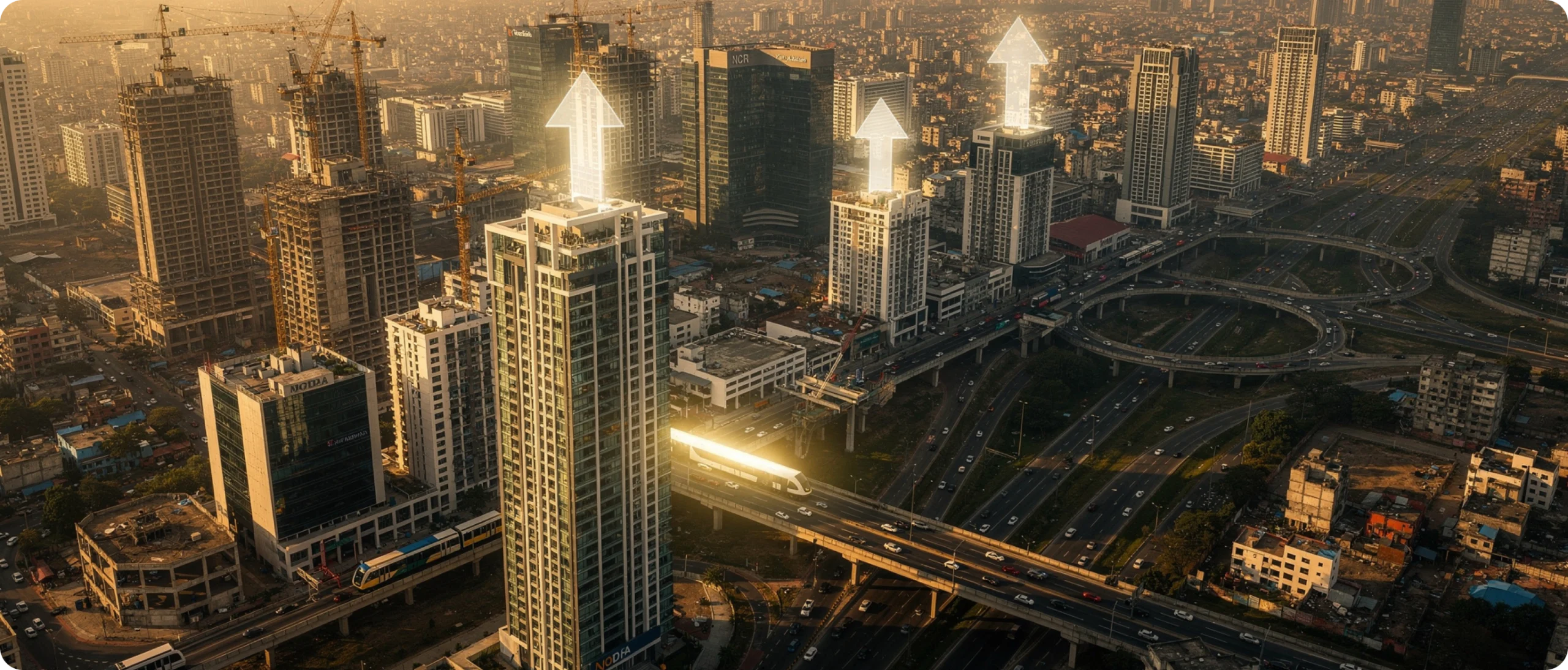
Noida and Ghaziabad stand out because residential growth is already visible in both cities, while the FNG Expressway adds future connectivity value. High-rise communities, township expansion, and active buyer interest make these two markets look stronger within the wider corridor.
Noida’s Established Growth Advantage
Noida continues to lead because of planned sectors, premium housing, commercial hubs, and steady project activity. With the FNG corridor expected to improve regional movement, the city holds both current residential demand and stronger long-term access value.
Ghaziabad’s Rising Urban Importance
Ghaziabad is becoming more relevant through township growth, broader road networks, metro connectivity, and improving links tied to the FNG corridor. Locations such as Siddharth Vihar are drawing attention because they combine better value, stronger access, and visible housing growth.
Why This Matters for Residential Buyers
This makes Noida and Ghaziabad more important for buyers comparing homes within the FNG belt. Both cities already offer visible development, stronger housing supply, and locations that may gain more attention as regional connectivity improves further over time.
The Practical Buyer View
Faridabad remains part of the wider FNG story, but Noida and Ghaziabad feel more actionable today for many homebuyers. They combine active residential markets with future corridor benefits, which helps them stand out more clearly in this regional growth discussion.
Final Thoughts on the FNG Corridor and Residential Growth Ahead
Where the larger story is moving
The FNG Expressway is not being viewed only as a road project. It is part of a broader shift in how Faridabad, Noida, and Ghaziabad are gradually being connected through movement, infrastructure, and future urban expansion.
Why this matters for housing
As connectivity becomes stronger, residential demand often increases in locations that already show active development, easier access, and better planning. This is one reason the corridor is being tracked closely by both homebuyers and investors.
Why Noida and Ghaziabad feel more active today
Among the three cities, Noida and Ghaziabad currently appear more active because they already combine visible housing growth, stronger residential supply, and improving links with the wider NCR region.
What this can mean going forward
For buyers, this corridor is not only about current housing options but also about future value. As the FNG story moves ahead, stronger micro-markets may continue drawing attention for both end use and long-term investment.